We’re back on the road! Find us in your area

We’re back on the road! Find us in your area

We getting out and about again in communities across Northumberland this summer! We’ll be heading to the venues below with our Annual Survey, goodie bags and information and signposting service, so do stop by to say hello, pick up a survey and some freebies.


Find us at:

  • Cafe @ Burn Lane, Hexham: Monday 21 June, 11.00am – 1.30pm
  • Outside the Co-op, Prudhoe: Wednesday 23 June, 9.30am – 12.00pm
  • Merton Road, Ponteland: Friday 25 June, 9.30am – 12.00pm
  • Market Square, Haltwhistle: Monday 28 June, 11.00am – 1.30pm
  • Outside Morrisons, Bedlington: Thursday 1 July, 9.30am – 12.00pm
  • Ashington Market: Tuesday 6 July, 9.30am – 12.00pm
  • Berwick Market: Wednesday 7 July: 10.00am – 12.30pm
  • Outside Bellingham Library: Friday 9 July, 2.00pm – 4.00pm
  • Morpeth Market: Wednesday 14 July, 9.30am – 12.00pm
  • Outside Morrisons, Amble: Thursday 15 July, 9.30am – 12.00pm
  • Outside Concordia Leisure Centre, Cramlington: Monday 19 July, 1.00pm – 3.30pm
  • Outside The Cheviot Centre, Wooler: Thursday 22 July, 1.00pm – 3.00pm
  • Blyth Market: Friday 23 July, 9.30am – 12.00pm


Our Annual Survey is a chance to tell us about the health and social care services you and your family have used over the last 12 months

With services working to bounce back from the COVID-19 pandemic, your views have never been more important and can play a crucial role to help us identify and address issues that affect the quality of people’s care.

You can also help us decide where to focus our work in the year ahead.

If you can’t get to one of our events, you can tell us about your experiences at the online survey or you can get in touch to ask for a paper copy and freepost envelope. If you would like to complete the survey over the phone with one of our friendly team please call 03332 408468 or text 07413 385275 to arrange a call back.


Tell us your story – in our Annual Survey 2021

Tell us your story – in our Annual Survey 2021

Our Annual Survey is a chance to tell us about the health and social care services you and your family have used over the last 12 months.

Your views and experiences continue to help professionals understand key local issues and how well services are working for you, your family and our communities.

With services working to bounce back from the COVID-19 pandemic, your views have never been more important and can play a crucial role to help us identify and address issues that affect the quality of people’s care.

You can also help us decide where to focus our work in the year ahead.

You can tell us about your experiences at the online survey or you can get in touch to ask for a paper copy and freepost envelope. If you would like to complete the survey over the phone with one of our friendly team please call 03332 408468 or text 07413 385275 to arrange a call back. Closing date is 23 July 2021.

We will be back in towns across the county this summer with our first ‘live’ events since last spring. Come and say hello if you can – we’ll have copies of the survey, our information and signposting service and some goodie bags to give away. See where we’ll be over the next few weeks: Healthwatch Northumberland – back on the Road

This survey has now closed.

Spotlight on: Vision Northumberland

Spotlight on: Vision Northumberland

As part of our Spotlight on… series we are shining a light on Vision Northumberland, formerly Northumberland County Blind Association.

Vision Northumberland is a local charity based in Morpeth which provides advice and support services to blind and visually impaired people to enable them to gain the knowledge, skills and confidence to live a fulfilled and independent life. It offers a home visiting service, clubs and support groups, telephone counselling, volunteer drivers to help clients get around, computer training, help with energy bills, low vision aids assessments and much more. Clients can also benefit from regular phone calls with the charity’s telephone support service, Client Connect (formerly Sightline).

Vision Northumberland’s volunteers based across the county have recently been honoured with The Queen’s Award for Voluntary Service, the highest award a voluntary group can receive in the UK.

The award recognises the vital support that the charity provided to the community in response to the pandemic by setting up a telephone befriending service with 91 volunteers making telephone calls. At the height of the pandemic over 600 visually impaired people were contacted to reduce isolation, loneliness and provide a lifeline during unprecedented times. Our very own Healthwatch staff team and volunteers were happy to be involved in this project.

You can get in touch by calling 01670 514316 or email info@visionnorthumberland.org.uk

GP data sharing

GP data sharing

NHS Digital has recently announced plans to allow an NHS system to extract patient data from doctors’ surgeries in England. The new data-sharing system was due to start in July but has now been pushed back to 1 September.

If you DO NOT want your GP records to be shared, there are two ways to opt out:

  1. Stop your GP record data being shared anonymously with other NHS services for planning and development. This would prevent your data being used in the anonymous information local NHS service commissioners and decision makers use to plan services. You will need to complete the form called Type 1 Opt out form and return it to your GP practice before 1 September. Find the Type 1 Opt out form here.
  2. Agree to share your information with the NHS planners but NOT with external research organisations. You can do this online here, via the NHS App or by calling 0300 303 56 78.
Healthwatch England has joined forces with leading patient groups to respond to the Government’s plans around GP data sharing.
NHS Digital has recently announced plans to allow an NHS system to extract patient data from doctors’ surgeries in England. The new data-sharing system was due to start in July but has now been pushed back to 1 September.
Responding to the announcement today by Jo Churchill, Minister for Primary Care, on the Government’s plans around GP data, Healthwatch England has released the following statement with other patient groups – National Voices, the Patients Association and the Richmond Group of Charities.
“We welcome today’s move by the Government to extend the deadline for the GP data opt-out and allow NHS Digital and colleagues across the NHS, particularly those in primary care, to have the time and space to engage properly with patients and the wider public on these plans.
“In previous engagement work the public have told us that they are in favour of the NHS using their data for medical research if they understand how this information will be used and can opt out if they so wish. However, ongoing public support for this depends on complete transparency and clear communication from the NHS when things change.
“Over the next few months we need to see a proper nationwide campaign on this, reaching out to people so they can make an informed choice about how their own individual medical records are used to support research. This is a complex issue, and so we will all be working with the NHS to help build awareness and understanding.”
You can help make health and care services better by sharing your experiences and ideas.
End of life care survey

End of life care survey

End of life care

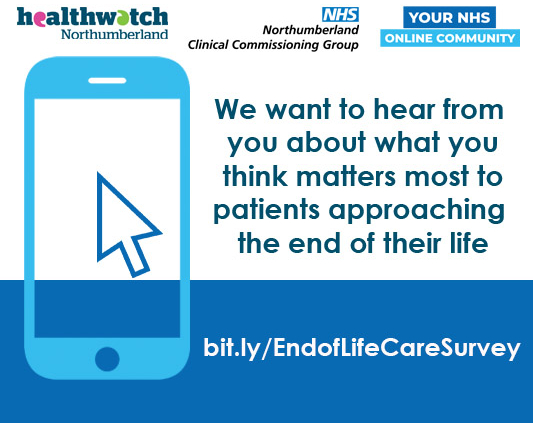
We are working with NHS Northumberland Clinical Commissioning Group to find out what is important to people living in Northumberland when thinking about end of life care. This feedback will help with the development of an end of life strategy, or plan, and the creation of an agreement between Northumberland residents and end-of-life care providers, such as doctors, nurses, carers etc.

This research is being carried out by independent agency  Explain Market Research.

To take part in this research please complete the online survey below by 5pm on Friday 25 June. 

As a thank you for taking part you will be entered into a prize draw to win a £100 Amazon voucher – just remember to leave your name and email address at the end of the survey.


Northumberland End-of-Life Online Survey

This survey is now closed.


Proposed changes at Felton and Widdrington surgeries

Proposed changes at Felton and Widdrington surgeries

Changes are planned at the Felton and Widdrington surgeries and patients have 12 weeks to give their views and ideas on the proposals. If you are a patient of either surgery you should have received a letter and an information sheet explaining the proposals and how you can share your views.

Healthwatch Northumberland is supporting the surgeries by holding two online engagement sessions via Zoom for patients who would like to discuss any concerns or ask a question.

The sessions will take place on Wednesday 9 June at 2.00pm-3.00pm and Thursday 17 June at 6.00pm-7.00pm.

This is an opportunity to give your views on the following:

  1. The proposal to merge both Felton and Widdrington surgeries
  2. The practice’s plan for a new surgery in Felton and the permanent relocation to these premises at a later date
  3. The potential temporary relocation to Widdrington Surgery should the practice need to move out of Felton, before the new build is complete.

Please email helenb@healthwatchnorthumberland.co.uk if you wish to attend and an invitation will be sent.

If you can’t make these sessions there are other ways you can get in touch:

  1. Write to the practice manager and mark it ‘Engagement Feedback’ – the address can be found at the top of your letter.
  2. Contact the practice manager by email at Felton.Surgery@nhs.net or Widdrington.Surgery@nhs.net with the title ‘Engagement Feedback’
  3. Ask the reception team at either practice for a feedback form. This can be filled out anonymously if you wish. You do not need to give any personal information if you choose not to.
  4. Contact Healthwatch Northumberland, the statutory independent champion for patients on 03332 408 468 (local call rate) or email info@healthwatchnorthumberland.co.uk.

The surgery will write a report based on this feedback in the late summer. The report will form part of the formal application to the Primary Care Commissioning Committee which will meet in August to decide if the proposals can go ahead.

Engagement how has now ended.

Volunteers’ Week 2021

Volunteers’ Week 2021

Six things to expect from social care

Six things to expect from social care

Six things to expect from social care services

People have told us here at Healthwatch that they want to feel listened to and involved in decisions about their social care. Here are six things you should expect from care services, according to new guidelines.

With more than a quarter of a million people living in care homes (current estimates are around 400,000) and a further estimated 608,145 adults relying on social care support to live independently, it’s vital that people are able to get the best out of social care.

The National Institute for Health and Care Excellence (NICE) has developed guidance to help you and social care professionals understand what care people can expect and how to support you to make decisions about your own care.

What should your care look like?

NICE has set out six key things you should expect from social care services:

  1. You should be able to live your life with dignity and independence.
  2. Your care should be planned flexibly around what you want and need.
  3. You should understand what types of care are available, and the minimum care you can expect to have.
  4. You should have control over how your care is provided and paid for.
  5. The staff providing care should develop good relationships with you.
  6. Providers of social care should ask you and your family for your views, and use these to train staff and improve services.

Having a say in your care

It’s important that professionals involve you in any decisions about your care. They should give you clear information about your different options and listen to your worries.They should also:

  • Find out what matters to you and what support you need to live the life you choose.
  • Give you information to make your own decisions, never assuming that you cannot decide for yourself.
  • Involve your family and carers too, if you are happy with this
  • Help you get your views across, for example using communication aids or by providing an advocate.

Find out more about what you should expect from social care.

Did your experience of social care meet all six points?

If you or a family member has used social care, let us know whether the service met these guidelines. Please get in touch and share your ideas for how social care services could improve in your area.

Healthwatch Dentistry Report

Healthwatch Dentistry Report

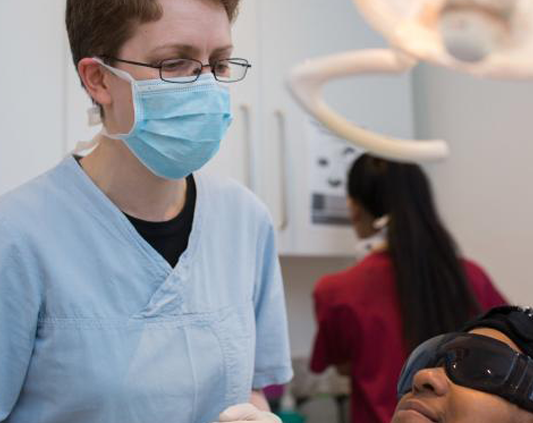
Access to NHS dental care continues to be a problem for people across England, with Healthwatch recording a 22% rise in calls and complaints about dentistry between January and March 2021.

Healthwatch England’s review of 1,375 people’s experiences found a lack of consistency across the country when it comes to accessing a dental appointment. Whilst some people were asked to wait an unreasonable time of up to three years for an NHS appointment, those able to afford private care could get an appointment within a week.

High cost of dental care

Whilst some people were charged £400 to get one tooth out, an individual reported being asked to pay over £7,000 for their dentures privately. But private treatment is not an option for everyone, with many people now struggling to pay even for NHS treatment. A poll of 2,019 adults commissioned by Healthwatch England found 61% of respondents felt that NHS dental treatments were expensive. The poll, which looked at people’s experiences of NHS dentistry during the pandemic and how it has impacted their future habits, found the following:

People’s experiences of NHS dental charges

  • Over a quarter (27%) of respondents said they either struggle to pay or avoid dental treatments altogether because they cannot afford the costs.
  • About one in three (30%) have reported they felt pressured into paying private fees to get all the dental treatment they needed. And nearly two in five (39%) reported that they had been charged extra for their NHS treatments.
  • Almost a quarter (23%) feel they will now visit the dentist only when they need treatment, despite clinical guidelines recommending regular dental check-ups to keep people’s mouths healthy.
  • Demographic groups who have been affected the most by the lack of NHS dental appointments and NHS dental fees include people on low incomes and those from ethnic minority groups – the same groups who have been worst hit by the COVID-19 pandemic.
  • Calling for equitable and affordable dental care

Reform of dentistry has been underway since 2009. Earlier this year, it was announced that NHS England would be taking over the process from the Department of Health and Social Care, but reform plans have yet to be announced.

In a recent report on the future of the NHS, the Lancet Commission stressed ‘an absence of affordability is a major barrier to dental care’ and suggested an abolition of patients’ co-payments to access and receive dental care.

We call for greater ambition and urgency from NHS dental reform plans to create more equitable and affordable dental care.

Imelda Redmond CBE, National Director of Healthwatch England, said “The twin crisis of access and affordability hitting NHS dentistry means many people are not able to access timely care – and the poorest are hardest hit. Those human stories show that oral health is a social justice and equity issue.

Reform of dental contracts needs to be a matter of urgency for this government. New arrangements should include making access to NHS dental services equal and affordable for everyone, regardless of where people live, their income and ethnicity. Failing to act now will result in long-term harm for thousands of people, putting even greater pressure on the already overstretched healthcare system.”

Income and regional disparities

Almost twice as many people from lower socio-economic groups (SEG) D and E struggle or can’t afford to pay NHS dental charges (37%) than people from the higher socio-economic group, A, (19%). As a result, people from SEG D and E are also twice as likely to avoid dental care due to affordability issues.

People living in the North East of England are the most likely to avoid NHS dental treatment due to costs (13%), compared with just one in 30 (3%) who live in the South West. Despite this, people in the North East have been charged for NHS dental treatments the most (29%), while people in the South West were charged the least (13%).

People from ethnic minority groups

Just over a quarter of people from ethnic minority communities (26%) reported they would go to the dentist for regular check-ups, compared to two in five (41%) of White people.  The survey also found that people aged over 55 from ethnic minority groups who are on low incomes were six times more likely to report avoiding dental treatments due to costs than their White counterparts.


If you would like to tell us your experiences of dental care over the last 12 months please get in touch.

Feedback Report January to March 2021

Feedback Report January to March 2021

Health and Social Care Feedback Northumberland January to March 2021

Part of our role here at Healthwatch Northumberland is to listen to people’s experiences of using NHS and social care services. This feedback is passed on to those providing and paying for services, so that they know what is working well for people living in Northumberland, and what could be better.

Our signposting and information service can help with all kinds of queries and issues, from finding a new GP or dental practice, helping people access services or raise a concern, to getting support with a particular condition.

This report shares a summary of the feedback collected from January to March 2021. During this period, we have continued to work in different ways due to the continuation of the Covid-19 pandemic. The next report will cover April – June 2021.

Between January and March 2021, we received feedback from 106 individuals from talking to people at online engagement events, telephone calls, emails, our website, social media, and other sources. We signposted 18 of these people to services.

This report looks at who we are hearing from across the county, presenting a summary of general respondent demographic information. Demographic information includes location, gender, age, and whether the respondent is sharing their own health and social care experience or speaking on behalf of a friend or relative.

We also look at the general sentiment of comments, with specific reference to the service type (e.g. primary care, secondary care, mental health, social care), as well as whether the feedback relates specifically to quality of care or access to services.

Healthwatch Northumberland Feedback Report January to March 2021